Free box size calculator · No sign-in needed
Box size calculator that knows the board.
Enter the size you know (your product’s inside space, the outside footprint or a converter’s score-to-score size) and get the other two for your structure and caliper, plus the flat blank, board area and knife length.
- 438 box structures
- 25 boards
- mm · cm · in
Size and preview for free. Sign in to continue in the editor. Dieline downloads require Pro or Business.
The mailer-box standard: white print liner, kraft inside.
The space your product needs. Measure the product at its largest and add clearance.
60–600
40–450
20–250
Size from a card deck
20–300 mm
20–300 mm
1–1000 cards
0.1–2 mm
Measure ten packed cards (with their sleeves) and divide by ten; the prefilled thickness is only a starting point.
0–5 mm
Stack 19.2 mm estimated: each 0.01 mm per card moves it 0.6 mm. Check it against a real stack before you order. Inside 90.9 × 65.5 × 21.2 mm.
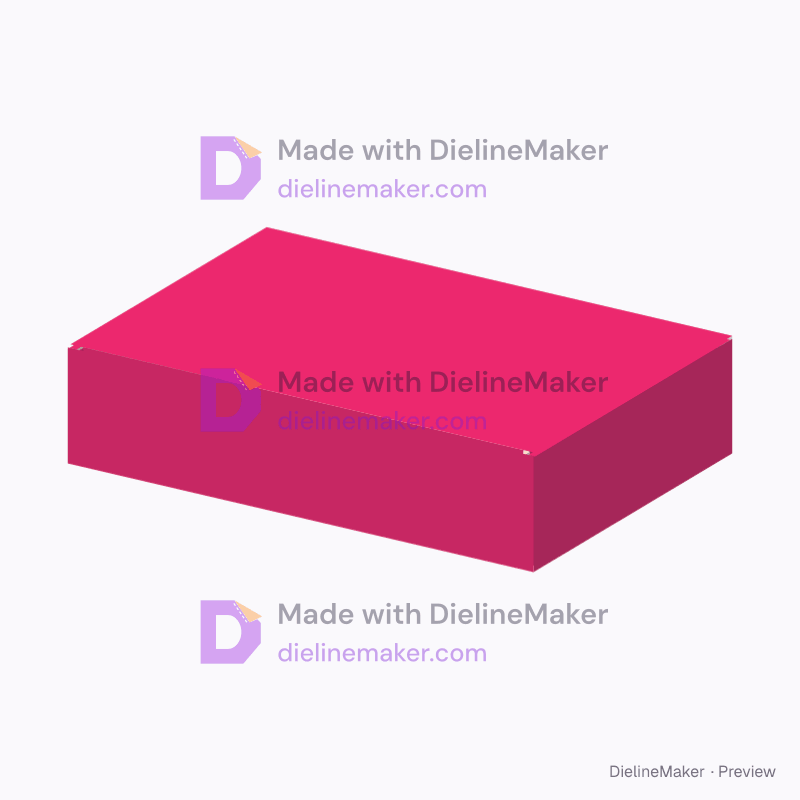
- Cut
- Crease
- Flat blank
- 514 × 533.2 mm
- Board per box
- 0.213 m²
- Knife (cut rule)
- 2.89 mCrease 2.70 m
- Caliper
- 1.6 mmE-flute W · E-flute
How it works
Product size in,
blank size out.
The numbers come from building the real dieline for your size and board, the same geometry the editor folds and exports.
- 01
Pick the structure
Tuck ends, mailers, shipping cases, trays, telescope and rigid boxes: each folds its walls its own way.
- 02
Choose the board
From 0.14 mm carton board to 4.6 mm double wall. The caliper drives every allowance on the blank.
- 03
Enter the size you know
Inside, outside or manufacturer’s. The other two are solved from the same dieline, so all three describe one blank.
- 04
Open the box
Continue in the editor with this exact size and board, or download the dieline as PDF, SVG or DXF.
Inside, outside, manufacturer’s
One box,
three honest sizes.
Every carton has three sets of dimensions. They differ by the board’s thickness, and mixing them up is the classic reason a product doesn’t fit.
Inside
The space between the inner faces of the board. Start here: it is what your product needs, plus clearance.
Manufacturer’s
The distance between the score lines on the flat blank. Converters set dies up from it; it sits half a caliper outside the inside per fold.
Outside
Across the outer faces of the folded box: what you need for shipping cases, shelf space and pallet patterns.
Why the board matters
Same inside,
four different boxes.
A 250 × 180 × 60 mm mailer (FEFCO 0427) built on four boards. The inside never changes; the outside, the blank and the board you buy do.
| Board | Caliper | Manufacturer’s | Outside | Flat blank | Board per box |
|---|---|---|---|---|---|
| SBS white board 350 g | 0.5 mm | 255 × 180.5 × 60.5 mm | 255.5 × 181 × 61 mm | 497.5 × 531 mm | 0.208 m² |
| F-flute micro corrugated | 0.9 mm | 259 × 180.9 × 60.9 mm | 259.9 × 181.8 × 61.8 mm | 503.5 × 531.8 mm | 0.210 m² |
| E-flute white / kraft | 1.6 mm | 266 × 181.6 × 61.6 mm | 267.6 × 183.2 × 63.2 mm | 514 × 533.2 mm | 0.213 m² |
| B-flute shipping | 3.2 mm | 282 × 183.2 × 63.2 mm | 285.2 × 186.4 × 66.4 mm | 538 × 536.4 mm | 0.221 m² |
Computed by the same engine as the calculator above, with each board’s typical mill caliper. Your converter’s measured caliper may differ slightly; the studio lets you override it.
Good to know
Questions,
answered.
Box dimensions, board caliper and blank sizes, answered.
Which dimensions should I give my printer?
Inside dimensions, unless they ask otherwise. The inside is what your product needs, and most box makers quote L × W × H as inside sizes. If a converter or a shipping spec gives outside or manufacturer’s sizes, enter those and switch the mode: the calculator works out the other two for the same blank.
What order do L, W and H go in?
Length is the longer side of the opening, width the shorter side, and height (depth) runs from the opening to the base. This is the order FEFCO and ECMA codes use, so a 250 × 180 × 60 mm mailer opens on its 250 × 180 face.
How much bigger is the outside than the inside?
It depends on how many layers of board each wall folds. A single wall each side adds two calipers (2T): 0.5 mm carton board adds about 1 mm, 3.2 mm B-flute about 6.4 mm. Mailers with rolled-over double side walls, trays with doubled ends and rigid boxes add more. The calculator measures the structure’s actual layers, axis by axis.
What is the manufacturer’s dimension?
The score-to-score size on the flat blank: the distance between the crease lines of a panel. A fold uses about half the board’s thickness, so a single-walled panel scores at the inside plus one caliper. Converters use it to set up dies, which is why some quotes and drawings give it instead of the inside.
How much clearance should I leave around my product?
Measure the product at its widest points and add enough that it slides in without forcing: often 1–3 mm per side in folding cartons, more in corrugated or when an insert holds it. Fragile or irregular products need an insert rather than a tight box. Always check with a physical sample.
Why was my size adjusted?
Each structure has a range it can be built in: a tuck end carton can’t be 5 mm tall and a mailer can’t be 2 m long. A size outside that range is moved to the nearest buildable one and the calculator says so, so the numbers you see always describe a real dieline.
How is the board weight worked out?
From the area of the die-cut blank (not its bounding rectangle) multiplied by the board’s grammage, for carton boards with a stated g/m². Corrugated and rigid boards are listed by caliper, not grammage, so no weight is shown for them.
Can I get the dieline for this size?
Yes. “Open this box” continues in the packaging editor with the same structure, size and board, where you can add artwork and see it fold in 3D. “Get the dieline” opens the studio’s export step for a print-ready PDF, SVG or DXF with cut and crease lines on separate layers.
Next: the dieline
Your size, your board, a dieline that fits.
Open any structure at your size, add artwork to every face, watch it fold in 3D and export a print-ready dieline with cut and crease layers.
